
Korea Aerospace University Professor Kim Hyun-kyu Featured in “Young Robotics Engineers” Series
- 2026-11-18
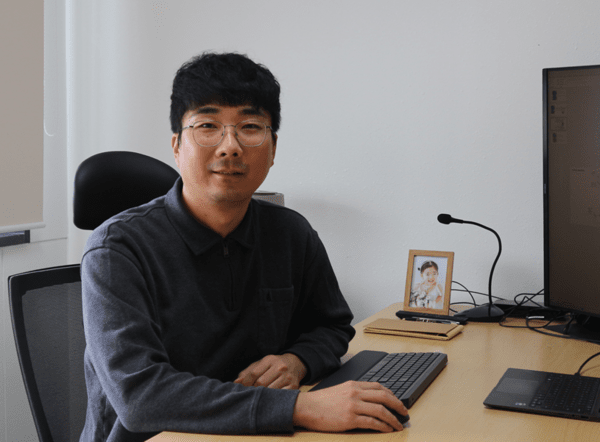
▲Professor Kim Hyun-kyu of the College of Engineering
Professor Kim Hyun-kyu of our university's College of Engineering has been featured as the 96th researcher in the “Young Robotics Engineers” series, jointly organized by Robot Newspaper and the Korea Robotics Society. Professor Kim earned his doctoral degrees in robotics and mechanical engineering from the University of Stuttgart in Germany and the Max Planck Institute for Intelligent Systems. After serving as a postdoctoral researcher at the Max Planck Institute for Intelligent Systems, he joined our university's College of Engineering as an assistant professor in September 2025. In 2023, he received the Best Paper Award from the University of Stuttgart for a collaborative research paper published in the international journal *Advanced Science*.
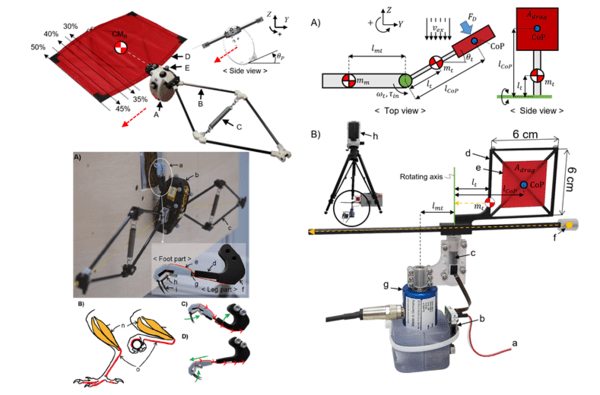
▲Structure and actuation mechanisms of a bio-inspired mobile robot
Professor Kim's primary research areas are bio-inspired mobile robots and industrial autonomous systems. He researches intelligent robots capable of overcoming obstacles and moving stably even in unpredictable environments such as rugged terrain. Inspired by the ways living organisms move, he focuses on developing robots that combine various modes of locomotion, including jumping, climbing, and gliding. In particular, he studies environmental adaptation technologies that enable robots to sense ground conditions and adjust their jumping and landing movements accordingly.
Another area of his research is autonomous construction robots that perform tasks such as assembling structures and transporting materials. He is conducting research to automate structural construction by integrating robotic mechanical design, motion planning, and digital-twin-based autonomous control technologies, enabling robots to handle a variety of construction materials. Recently, he has expanded the scope of his research beyond conventional wooden structure assembly to address a wider range of shapes and materials.
Professor Kim also expressed his goal of extending his research on mobile and construction robots into space environments. Based on environmental adaptation technologies developed through research on rugged terrain on Earth, he plans to develop exploration robots capable of navigating irregular terrain and low-gravity conditions on the Moon and other planetary surfaces. He also aims to apply autonomous construction technologies to the assembly and construction of structures in space. Ultimately, his goal is to enable robots to independently perceive their surroundings and carry out everything from exploration to structural construction in space environments that are difficult for humans to access or work in.
He identified one of the key challenges in robotics research as integrating technologies from various fields, including mechanical design, electronic circuits, control systems, and artificial intelligence, into a single system and ensuring that it operates reliably in real-world environments. To students pursuing robotics, he advised that it is important to build a solid foundation in their own major while remaining interested in other fields, and to gain experience by implementing and experimenting with what they have learned.
He also emphasized that, to advance Korea's robotics industry, AI and computing technologies should be actively applied not only to the practical use of robots but also to their design and development processes. He stated that these technologies should be combined with mechanical engineering capabilities in design and manufacturing to improve the performance of existing robots and encourage more efforts to develop robots based on new concepts.

76, Hanggongdaehak-ro, Deogyang-gu, Goyang-si, Gyeonggi-do, 10540, Korea
Phone - +82-2-300-0114 FAX - +82-2-3158-5769 E-mail - webmaster@kau.ac.kr
COPYRIGHT 2022 Korea Aerospace University. All right reserved.