
Aerospace Engineering Student Yang Jun-young (Class of 2022) Successfully Launches GBSAT CubeSat Aboard the Fifth Nuri Rocket
- 2026-10-28
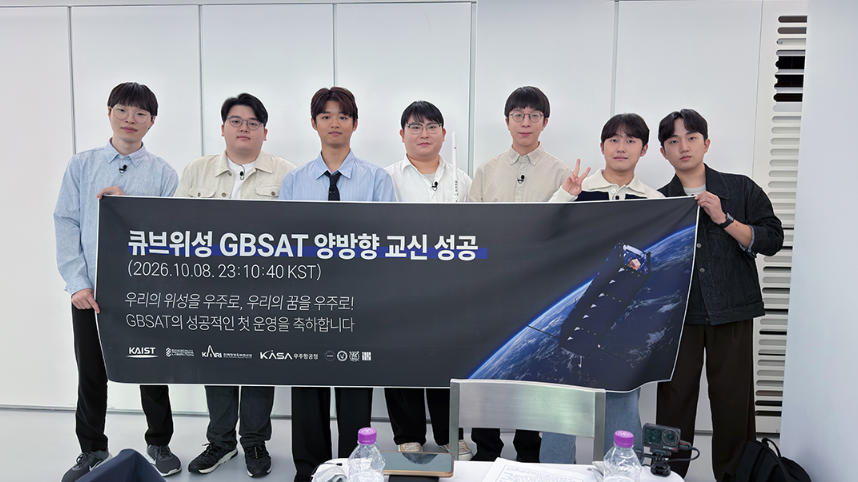
Yang Jun-young is in the center of the photo.
On October 7, at the Naro Space Center in Goheung, South Jeolla Province, eyes remained fixed on the screens long after the Nuri rocket rose into the sky. Once the rocket reached its target orbit, it deployed CubeSats two at a time into space, and finally, the deployment of GBSAT was confirmed. Yang Jun-young, a fourth-year student in Aerospace Engineering and the project manager (PM) of GBSAT, was on standby inside the center to witness the moment. Only then did he finally breathe a sigh of relief.
GBSAT began when seven alumni of Gyeonggi Buk Science High School reunited after enrolling at Korea Aerospace University, KAIST, DGIST, Seoul National University, and GIST. They entered the Korea Aerospace Research Institute’s CubeSat competition as first-year undergraduate students, even though the competition had traditionally been dominated by university research laboratories. Their efforts earned them the opportunity to launch their satellite aboard the Nuri rocket. Inspired by this experience, Yang gained the confidence to pursue a career in the space industry and founded VF SPACE the following year. Last summer, he was featured on our university’s website as the head of VF SPACE, a space startup developing metal 3D printers and sounding rockets. We spoke with him about what happened after the deployment of the satellite that helped launch his entrepreneurial journey.
Q. Three of the ten CubeSats carried aboard the fifth Nuri launch were developed by professors and students from our university. What was your first thought when you confirmed that GBSAT had been deployed?
“I watched anxiously from liftoff until our satellite was deployed. I was relieved when I confirmed that the deployment had succeeded, but at the same time, I realized that this was only the beginning. From that moment on, I just hoped that GBSAT would operate without any problems.”
Q. What is the current status of GBSAT?
“It is in the initial operations phase. Immediately after deployment, the satellite’s rotation rate, or angular velocity, was higher than expected, and we also found some software bugs. We are working to resolve these issues. They are problems we can address, and progress has been smooth, so we expect the satellite to carry out its mission. Once initial operations are complete, GBSAT will measure high-energy protons aligned with Earth’s magnetic field throughout its operational lifetime and transmit the data to Korea whenever it passes over the Korean Peninsula.”
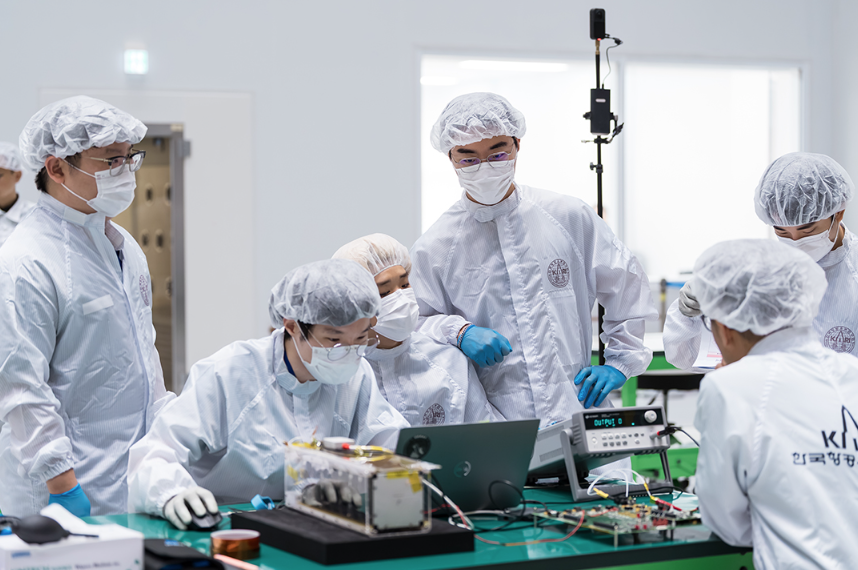
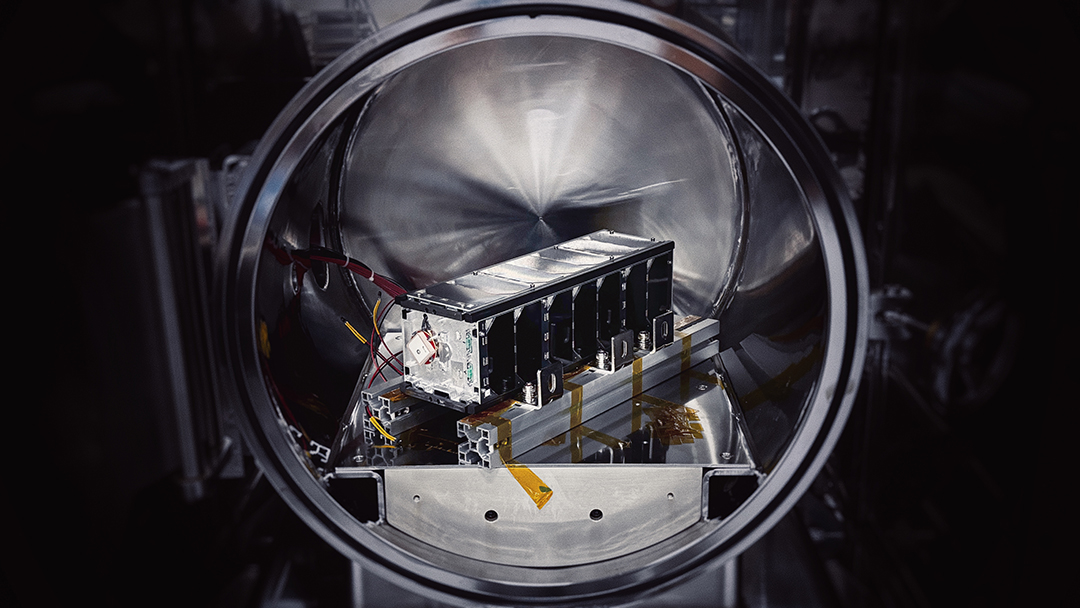
Photo courtesy of the Korea Aerospace Research Institute.
Q. What kind of space radiation does GBSAT measure, and why is it important to measure it?
“Our mission is to measure protons with energies above 50 megaelectronvolts (MeV) that are aligned with Earth’s magnetic field. High-energy protons are a form of space radiation. Just as radiation can be dangerous to people, exposure to space radiation can cause various malfunctions and errors in satellites, potentially resulting in critical failures. We hope the proton data collected by GBSAT will help other satellites develop countermeasures in the future. The measurements are also scientifically valuable. High-energy protons generally originate from beyond the inner solar system, and during periods of intense solar activity, they have difficulty penetrating into the solar system. Therefore, we believe the data could also be used to compare and analyze high-energy proton levels alongside solar activity.”
Q. You watched the first Nuri launch in 2021 from your high school classroom.
“I had been interested in launch vehicles since high school, so my friends asked me how I felt about the launch. I was used to watching Falcon 9 launches, so seeing a launch vehicle developed by our own country rise into the sky was incredibly exciting. Some friends asked whether the launch had succeeded. I remember telling them that the engine burn seemed to have ended earlier than scheduled because I had memorized the Nuri launch timeline.”
Q. The friends who worked with you reunited the year after entering university. How did the project begin?
“Lee Sang-hoon, who was studying at DGIST at the time, first suggested entering the competition. He is now pursuing a master’s degree at KAIST. It was shortly after the COVID-19 pandemic, and the competition announcement came out around April. Since I did not know many people at my university, I thought about gathering friends from high school. I contacted those who might be interested in the project. The competition was usually entered by university research laboratories, but as first-year students, we did not really know that, so we simply decided to form our own team. Professor Yoon Hyo-sang of KAIST agreed to serve as our faculty advisor.”
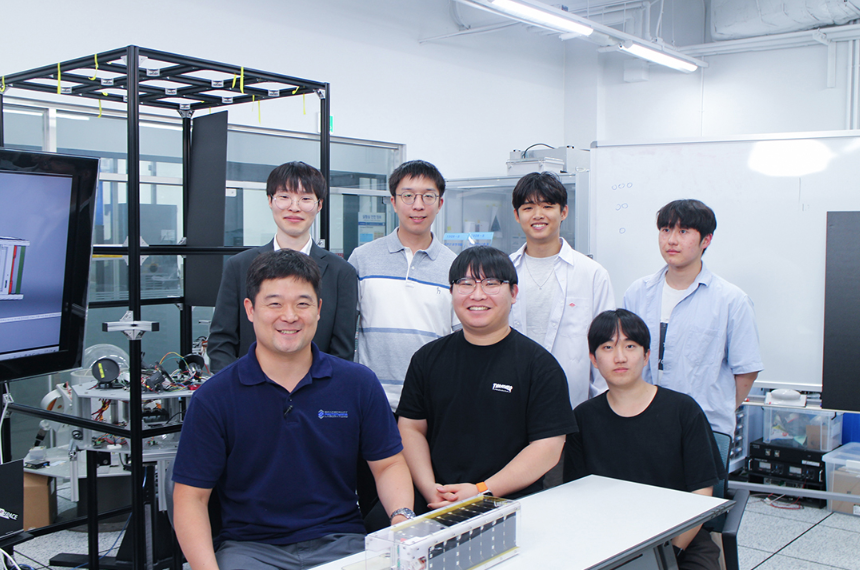
The team members who developed GBSAT. In the front row, the first person from the left is Professor Yoon Hyo-sang of KAIST, followed by CEO Yang Jun-young.
Q. What does the name “GBSAT” mean?
“All seven team members were graduates of Gyeonggi Buk Science High School and were first-year undergraduates at the time. Since Korean CubeSats have generally been named by combining an institution’s name with ‘SAT,’ we took ‘GB’ from Gyeonggi Buk and named our satellite GBSAT.”
Q. You served as project manager. What were your responsibilities during development?
“I was the PM and was also responsible for developing the attitude determination and control system (ADCS). I occasionally worked on the ground support equipment (GSE) as well. Although I led the team, everyone started with similar levels of knowledge and experience, so we operated on a relatively equal footing.”
Q. What was the most challenging obstacle during development?
“It was when we could not resolve a malfunction in the command and data handling system (CDH) for an entire year. Satellites in space can readily experience temperatures ranging from around -15°C to 60°C, but a particular component was failing at -5°C, contrary to our expectations. It took more than a year just to solve that problem, and I learned firsthand how difficult satellite development can be.”
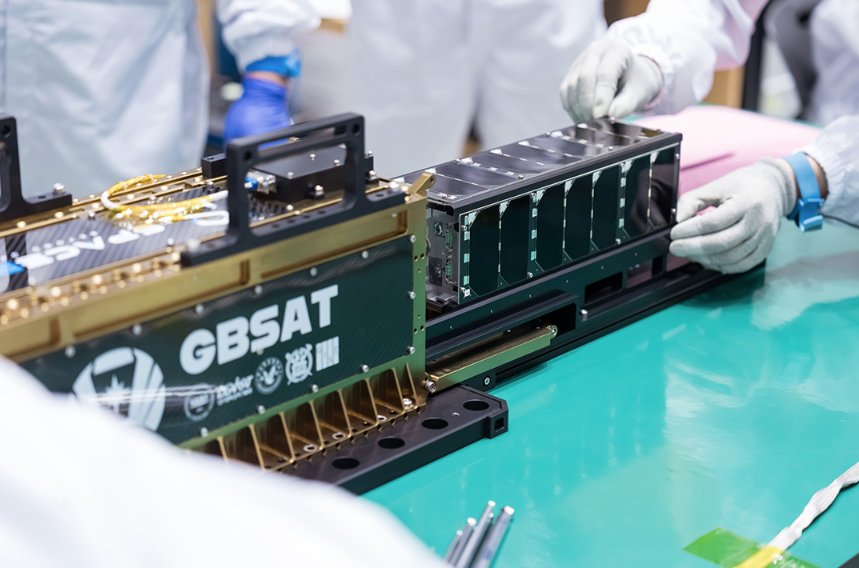
Photo courtesy of the Korea Aerospace Research Institute.
Q. You said the competition helped accelerate your decision to start a company. Now that the satellite you developed has actually reached orbit, how do you see the connection between the competition and entrepreneurship?
“Being selected for the competition and gaining experience developing a satellite gave me confidence. It made me feel that I could overcome what had seemed like an almost insurmountable barrier to entering the space industry, and that confidence led me to start my own company. Of course, I also realized that there is a substantial gap between satellites and launch vehicles. I had assumed that, since both are iconic space technologies, they would share similar knowledge and principles, but each presents its own distinct challenges. Even if you know how to build a launch vehicle, you would probably have to study satellite engineering from the beginning, and the reverse is also true. VF SPACE is currently developing metal 3D printers and launch vehicles, so we may move away from satellite development for a while after GBSAT. Still, I am certain that we will eventually draw on this experience to develop satellites again.”
Q. Finally, what would you like to say to younger students who want to build satellites?
“The hardest thing about a satellite is that once it goes into space, you can no longer intervene directly. That creates enormous pressure, but paradoxically, it is also why discovering that the satellite is still alive and functioning feels so rewarding. I hope you will give it a try. Not a single member of our team had studied satellite engineering before. I hope no one will be intimidated by the barriers to entering the space industry.”

GBSAT team members (Name / Current affiliation / Responsibility / Affiliation during development)
Yang Jun-young / Korea Aerospace University, Aerospace Engineering / Project Manager (PM), Attitude Determination and Control System (ADCS) / School of Aerospace and Mechanical Engineering at the time
Lee Sang-hoon / KAIST, Interdisciplinary Graduate Program in Space Exploration Engineering, master’s student / Payload / DGIST Undergraduate Studies at the time
Lee Je-min / KAIST, Department of Aerospace Engineering / Command and Data Handling System (CDH) / KAIST Freshman Year Program at the time
Jung Beom-jun / DGIST, Mechanical Engineering / Thermal Control System (TCS) / DGIST Undergraduate Studies at the time
Kim Hyun-min / DGIST, Computer Science and Engineering / Communication System (CS) and Electrical Power System (EPS) / DGIST Undergraduate Studies at the time
Lee Tae-gyun / Researcher at the Agency for Defense Development, currently serving mandatory service / Payload / GIST School of General Education at the time
Bang Woo-chan / Seoul National University, Department of Physics Education / Structural and Mechanical System (SMS)
Faculty advisor: Professor Yoon Hyo-sang, KAIST
VF SPACE Co., Ltd. is a space startup founded by Yang Jun-young in August 2023. The company develops wire-laser additive manufacturing (WLAM) metal 3D printers and hybrid-engine-powered sounding rockets. It was selected as a family company of the Korea Aerospace Research Institute and successfully launched its sounding rocket, “Hyperion Junior,” in March this year.

76, Hanggongdaehak-ro, Deogyang-gu, Goyang-si, Gyeonggi-do, 10540, Korea
Phone - +82-2-300-0114 FAX - +82-2-3158-5769 E-mail - webmaster@kau.ac.kr
COPYRIGHT 2022 Korea Aerospace University. All right reserved.