
DEEPX CEO Kim Nok-won and KAIST Professor Ahn Sung-jin Return to Their Alma Mater to Share Insights on the Future of AI
- 2026-11-13
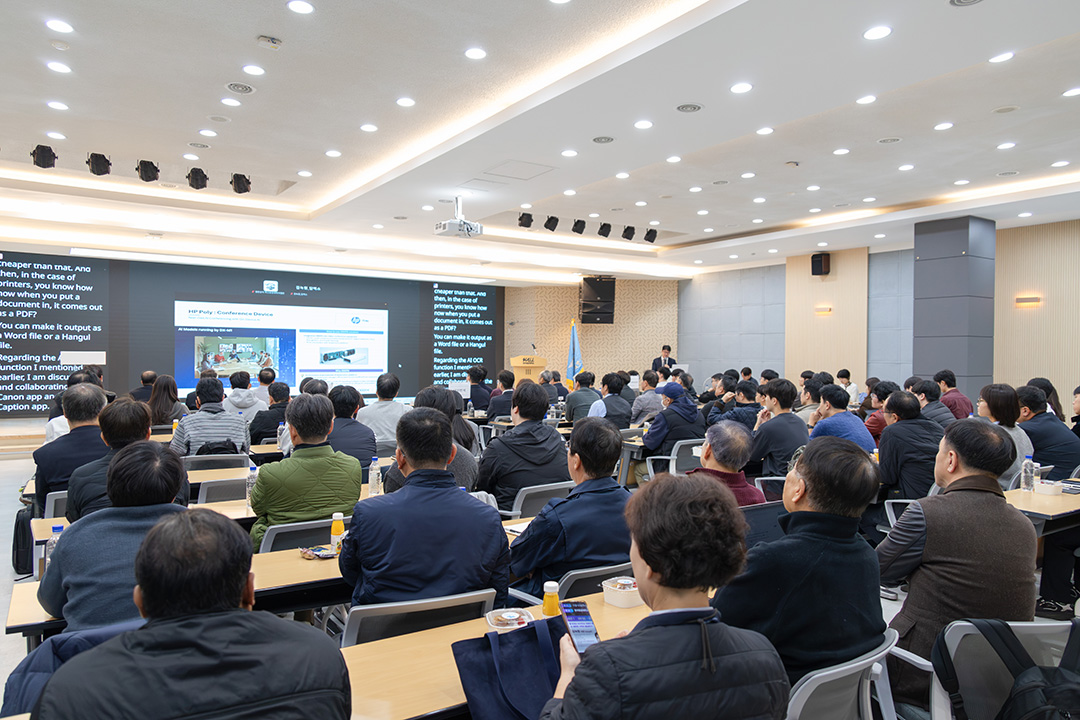
Kim Nok-won, CEO of DEEPX (Class of 1997, Department of Avionics Engineering), and Ahn Sung-jin, professor at the School of Computing at KAIST (Class of 2000, Computer and Information Engineering major), delivered lectures at an AI expert seminar titled “Physical AI and World Models: The Future of Next-Generation Artificial Intelligence.” The seminar was held on the second floor of the Vision Hall at our university’s Aerospace Center on November 12. The two alumni, both active in the AI field, returned to their alma mater to share with current students the latest developments in physical AI and research on next-generation AI models. The seminar was organized by the Next-Generation Communications Innovation Convergence University Project Group as part of the Ministry of Education’s Advanced Fields Innovation Convergence University Project.
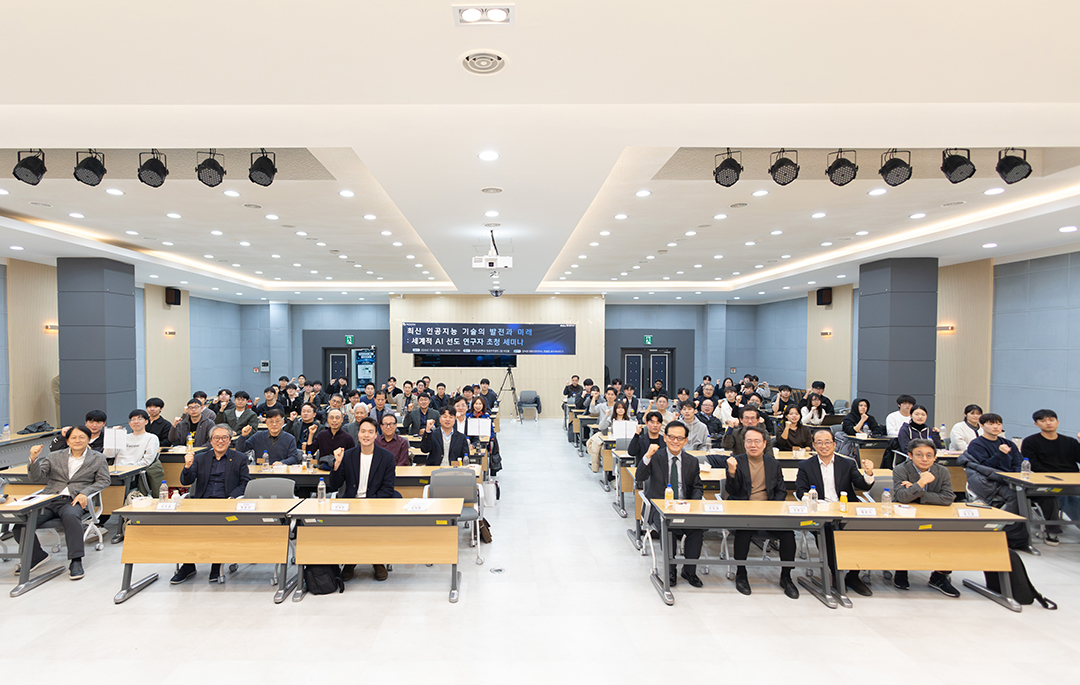
The event was attended by President Heo Hee-young; Ahn Jun-seon, Dean of the College of AI Convergence; Kim Jin-ki, Dean of the College of Aviation Management; Hwang Wan-sik, Director of Planning; Yoon Ji-jung, head of the Next-Generation Communications Innovation Convergence University Project Group; Lee Soo-geun, President of Korea Airports Corporation; and Park Jun-seok, head of the Next-Generation Communications Innovation Convergence University Project Group at Kookmin University. Students, faculty members, and industry representatives also filled the venue.
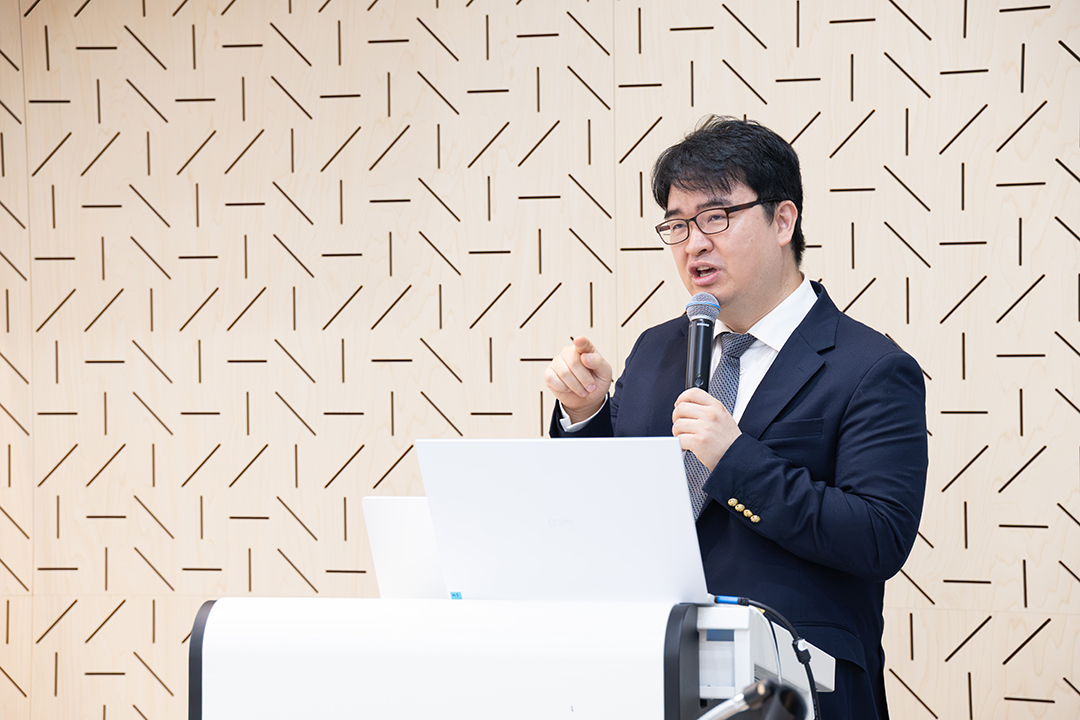
The first speaker, Kim Nok-won (pictured above), spoke on the topic “Why We Need to Build a Physical AI Ecosystem in the Post-NVIDIA Era.” Kim earned his master’s degree from Korea University and his Ph.D. from the University of California, Los Angeles (UCLA). After working on chip design at Apple, he founded DEEPX, an on-device AI semiconductor company, in 2018. He explained that running AI on battery-powered devices such as robots, mobility platforms, and smart factory equipment requires dedicated semiconductors with lower power consumption and heat generation, rather than graphics processing units (GPUs). The neural processing units (NPUs) developed by DEEPX are precisely this type of semiconductor, and are being adopted across various industries thanks to their low power consumption, low heat generation, and price competitiveness.
DEEPX is expanding its customer base through partnerships with companies including Hyundai Motor Group and China’s Baidu. Kim outlined his vision of turning every competitor into a partner to grow the ecosystem as much as possible, saying, “When we build it, it becomes the new normal.” He also expressed confidence in the development of the company’s own software platform, saying, “We can connect with anyone and we have our own technology, so we can complete it within two to three years.”
He also introduced the company’s achievements to date. DEEPX has won five Innovation Awards at CES 2024 and CES 2026, and its next-generation chip was also selected as a CES 2027 Innovation Award honoree. The company has filed more than 600 patents to date. Kim told the students, “You should pursue something that others think is impossible but that you believe is possible, and that has tremendous value. That is what people call innovation.”
After the lecture, a student aspiring to start a business raised a hand to ask for advice. Kim responded that AI is rapidly accelerating development, and that something which took him ten years to build could now be achieved in two to three years if someone started today. He therefore advised against starting a business based on chips at this point. Comparing AI agents to doctoral-level personnel, he added, “Forget traditional entrepreneurship. If you were in a position to use the smartest Ph.D. researchers without limit, you would need to rethink what kind of business you should start.”
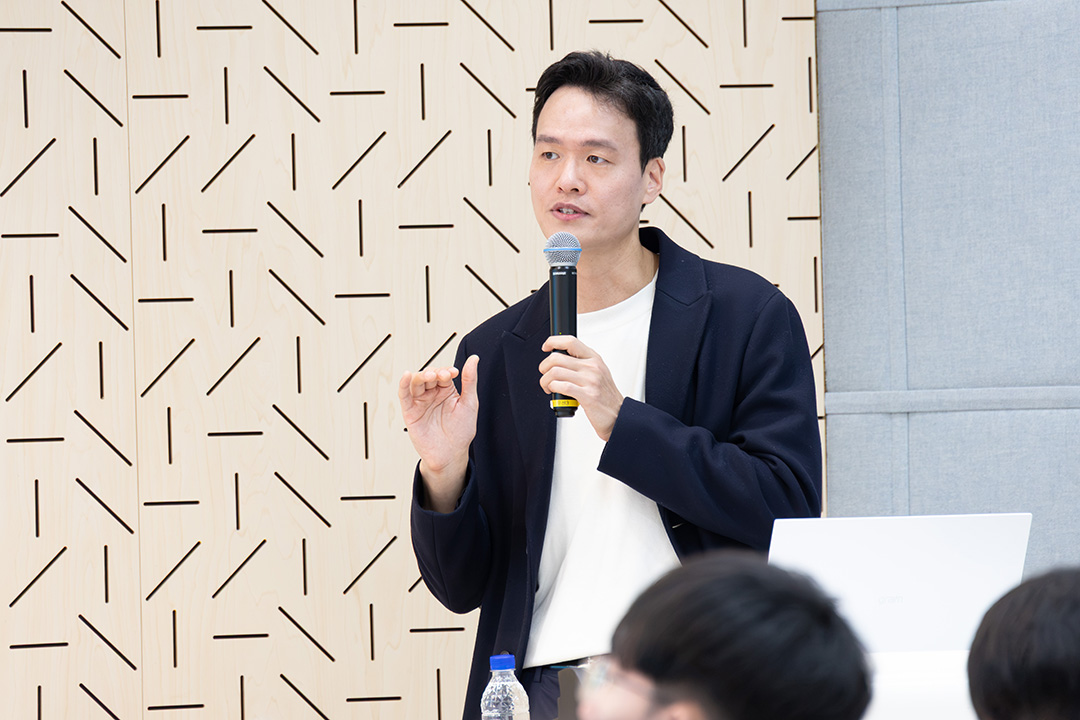
In the second lecture, Professor Ahn Sung-jin (pictured above) introduced his research direction under the title “Proposing a New AI Model Based on World Theory.” Ahn earned his master’s degree from KAIST and his Ph.D. from the University of California, Irvine. He completed postdoctoral research under Professor Yoshua Bengio, a Turing Award laureate often described as a Nobel Prize winner in computer science, and went on to serve as a professor at Rutgers University in the United States before joining KAIST, where he currently works. He is now collaborating with Professor Bengio on a South Korean government-funded project focused on “World Theory Models,” which aim to overcome the limitations of existing artificial intelligence models.
Professor Ahn identified the “world model” as the core engine of AI. A world model refers to a model in which AI internally learns how the world works. He explained its development in three stages: Stage 1, recognizing and representing objects in a scene; Stage 2, predicting what will happen next; and Stage 3, formulating theories about underlying principles. Current research attracting attention in the field of world models corresponds to the second stage. Professor Ahn believes that future research must move beyond prediction and advance to the stage of theory formation.
Accordingly, Ahn’s research focuses on developing a new AI model that can independently discover the laws of the world through observation alone and combine those discoveries to respond to unfamiliar situations. He explained that this ability to formulate theories is one of the most fundamental capabilities of both physical AI and human intelligence.
He also shared with the students his experiences in taking on new research topics. Ahn said that students tend to feel comfortable researching widely known subjects but are often hesitant to pursue unfamiliar types of research. He added that it had taken time to gain the trust of students who joined this project. The research, in which students invested six to eight months, was selected for an oral presentation at the International Conference on Machine Learning (ICML 2026) in July this year and also received the Best Paper Award at a workshop held during the same conference. He added that it was “a topic that we can enjoy researching for at least another three years.”
Concluding the seminar, President Heo Hee-young announced that, given the strong interest from industry professionals and professors, the university would make the seminar a regular event in the form of a colloquium held once or twice a year.
- Prev Korea Aerospace University Joins Kyungpook National University, Gyeongsang National University, SeoulTech, and Jeonbuk National University to Strengthen Cooperation in AI Defense and Aerospace
- Next Korea Aerospace University Signs Mutual Cooperation Agreement with Gyeonggi Provincial Office of Education to Innovate Future Education

76, Hanggongdaehak-ro, Deogyang-gu, Goyang-si, Gyeonggi-do, 10540, Korea
Phone - +82-2-300-0114 FAX - +82-2-3158-5769 E-mail - webmaster@kau.ac.kr
COPYRIGHT 2022 Korea Aerospace University. All right reserved.