
[Professor Lim Sang-min's Column] The AI Pilot Competition and Challenges for Future Aerial Combat
- 2026-11-09
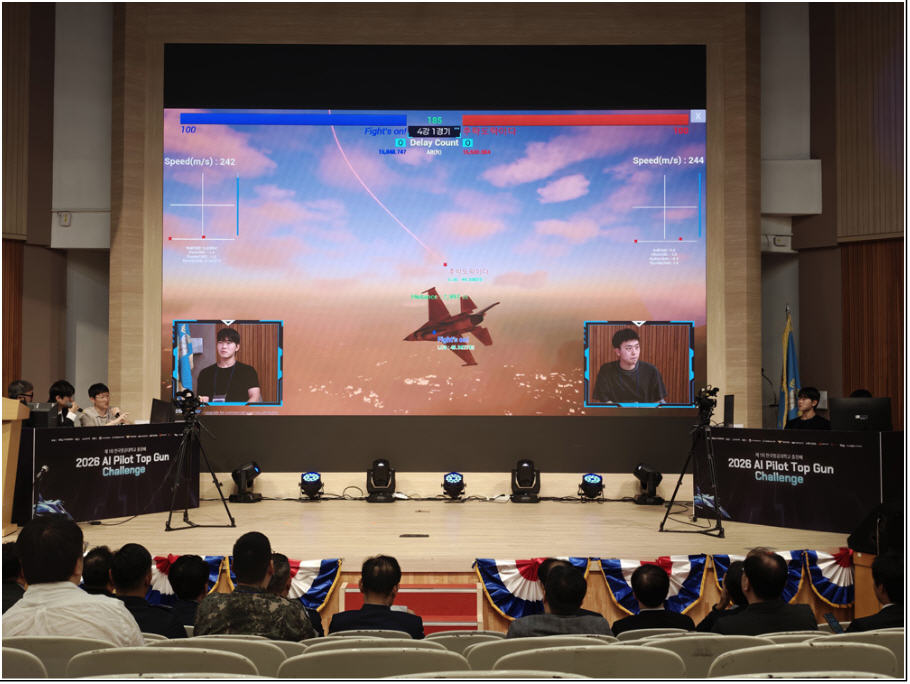
▲ AI aerial combat engagement at the '2026 AI Pilot Top Gun Challenge'
The “2026 AI Pilot Top Gun Challenge,” held last September, demonstrated the potential of artificial intelligence (AI) developed by university students to control fighter aircraft and perform aerial combat maneuvers. A total of 290 teams and 873 participants from more than 80 universities nationwide applied for the competition, with 16 teams advancing to the final round after preliminary screening.
Traditionally, aerial combat has relied heavily on pilots’ judgment, instantaneous flying skills, and physical endurance under high gravitational forces. However, the emergence of AI pilots is changing the nature of aerial combat. In addition to aircraft control capabilities, software that can accurately assess situations and s e l e c tadvantageous maneuvers is becoming increasingly important.
Participating teams developed their aerial combat algorithms using two main approaches: behavior trees and reinforcement learning. Behavior trees operate according to rules defined by developers, while reinforcement learning enables AI to learn advantageous actions through repeated simulations. Teams using reinforcement learning won first and second place. Other participants also demonstrated creative approaches, including combining the two methods and establishing parallel learning environments.
The competition also highlighted several challenges that the Republic of Korea Air Force must address in preparing for future aerial combat. First, it needs evaluation criteria that assess both combat performance and safety. Second, a standardized virtual aerial combat testing environment should be established for joint use by civilian and military organizations. Third, a phased verification system is needed to translate simulation results into the operation of actual aircraft.
The competitiveness of future aerial combat cannot be secured by acquiring advanced fighter aircraft alone. AI software that enables cooperation between manned and unmanned aircraft, along with specialists capable of developing and verifying that technology, will be essential. Continued cooperation among industry, academia, research institutions, and the military, as well as sustained talent development, will be crucial to turning university students’ challenges into research and development, flight testing, and operational deployment.

76, Hanggongdaehak-ro, Deogyang-gu, Goyang-si, Gyeonggi-do, 10540, Korea
Phone - +82-2-300-0114 FAX - +82-2-3158-5769 E-mail - webmaster@kau.ac.kr
COPYRIGHT 2022 Korea Aerospace University. All right reserved.