
Cooperation with the Uzbek Government to Build a Central Asian Aviation Talent Hub
- 2026-05-07
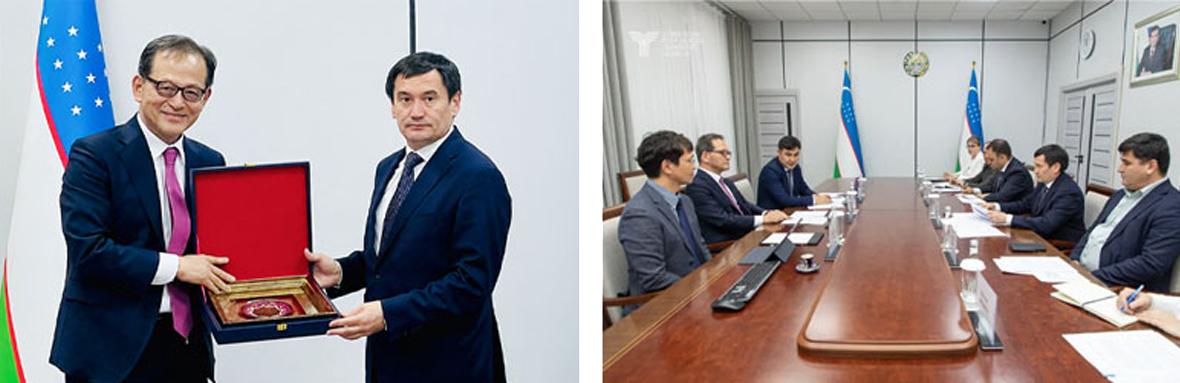
Korea Aerospace University is set to become a “game changer” in the Central Asian aviation industry through its partnership with the Uzbek government. President Heo Hee-young announced that, during a meeting with Uzbekistan’s Minister of Transport, the two sides finalized a step-by-step cooperation plan aimed at developing Uzbekistan into a regional aviation hub.
On April 29 (local time), President Heo met with Minister of Transport Ilkhom Mahkamov at the Ministry of Transport headquarters in Uzbekistan and proposed a “strategic master plan” to foster Uzbekistan as a Central Asian hub for aviation workforce training. The meeting drew considerable attention, with even officials at the Korean Embassy in Uzbekistan commenting that arranging a direct meeting with the minister was extremely difficult. After listening carefully to President Heo’s proposal, Minister Mahkamov instructed his staff to move forward with the project without delay.
President Heo also highlighted potential risks that could arise from the rapid expansion of Uzbekistan’s aviation market, citing historical examples to emphasize the importance of establishing a strong safety management system and a stable workforce supply structure that can keep pace with aircraft acquisitions. To address these challenges, Korea Aerospace University proposed a master plan centered on:
△ consulting on the establishment of an International Flight Training Center at Navoi International Airport,
△ consulting on the development of a National Aviation Safety and Security Center, and
△ introducing customized pilot training curricula tailored to industry demand.
In particular, the proposal gained strong trust from the Uzbek side because it included a contingency plan for outsourced training in Korea in case local infrastructure development is delayed, thereby ensuring operational continuity.
President Heo stated, “The cooperation between Korea Aerospace University and Uzbekistan goes beyond educational exchange. It is about building strategies to strengthen the competitiveness of Uzbekistan’s aviation industry. By sharing our experience and expertise in aviation training, we hope to contribute to making Uzbekistan a major aviation hub in Central Asia.”
Both sides also agreed to launch a Joint Working Group within the second quarter of this year. The group will oversee the establishment of the Navoi International Flight Training Center, procedures for introducing aircraft and simulators, and the development of a training system for aviation safety inspectors, opening a new chapter in aviation workforce development in Uzbekistan.
Meanwhile, on the same day, President Heo signed a 2+2 dual degree agreement with Tashkent State Transport University (TSTU) for programs in Aviation Management and Air Transport Logistics. The two universities have already been operating a 1+2+1 dual degree program in Flight Operations since the second semester of the 2025 academic year, and this latest agreement further expands the scope of academic cooperation.
The program is expected to serve as a key pathway for securing future faculty members who will lead aviation education in Uzbekistan. Korea Aerospace University also plans to connect outstanding graduates to master’s degree programs and cultivate them into expert professionals capable of directly operating educational systems tailored to Uzbekistan’s local aviation environment.

76, Hanggongdaehak-ro, Deogyang-gu, Goyang-si, Gyeonggi-do, 10540, Korea
Phone - +82-2-300-0114 FAX - +82-2-3158-5769 E-mail - webmaster@kau.ac.kr
COPYRIGHT 2022 Korea Aerospace University. All right reserved.